Bringing the Customer Into Merchandising Strategy

Executive Summary
As Staples Canada was developing its three-year merchandising strategy, I recognized an opportunity to strengthen its strategic foundation: customer perception needed to be a deliberate input into category strategy and enterprise positioning.
I initiated and led a customer-led strategic initiative, securing sponsorship from the Chief Merchandising Officer (CMO) and engaging his executive leadership team of Vice Presidents and Divisional Vice Presidents.
Using a customer-value positioning framework I designed, I challenged leaders to examine how customers perceive their categories today, define their desired positioning three years into the future, and identify the strategic choices needed to close the gap.
I extended the initiative beyond the workshop, integrating customer research, competitive intelligence, purchase-funnel analysis, and category economics to develop differentiated strategic recommendations and a proposed planning agenda.
The work established a clearer connection between customer perception, category strategy, and enterprise value positioning - helping merchandising leaders consider not only how individual categories compete, but how their collective choices shape what Staples stands for in customers' minds.
Strategic Initiative & Ownership
I created this initiative because I saw an opportunity to strengthen a consequential enterprise strategy before its direction was finalized.
Although merchandising strategy was outside my direct functional mandate, I recognized that customer understanding could improve how leaders evaluated category opportunities, competitive positioning, and commercial trade-offs.
I developed the strategic proposition, secured the CMO's sponsorship, and owned the initiative from concept through executive engagement, workshop design and delivery, and strategic recommendations.
Scope of ownership: Identifying the opportunity, defining the strategic approach, developing the customer-value framework, securing executive commitment, leading the leadership workshop, and developing the recommended next-stage planning agenda.
The merchandising organization retained accountability for the three-year strategy, commercial investment decisions, and execution.
Diagnose
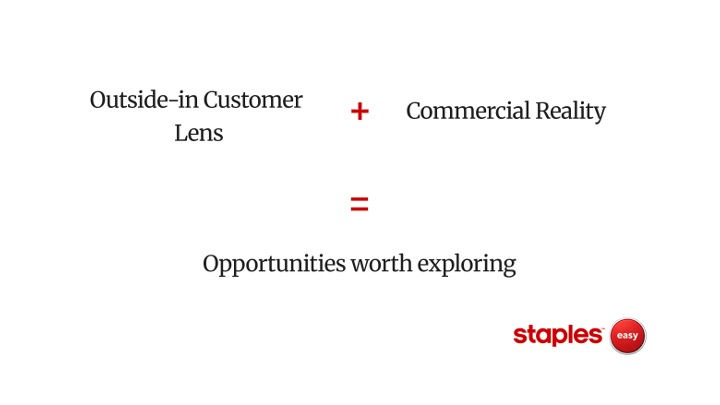
A three-year merchandising strategy needs to answer two fundamental questions: Where will we compete, and how will we win?
For a multi-category retailer, those decisions cannot be based solely on financial performance, competitive pricing, or assortment. They must also reflect why customers choose the retailer, what value they expect, and how different categories contribute to the overall customer proposition.
At the category level: Customer needs and expectations vary by shopping mission. A customer purchasing technology, everyday office supplies, or workplace essentials may define value differently. A uniform approach to price, quality, assortment, or differentiation would overlook these differences.
At the enterprise level: Customers experience Staples as one brand. The collective choices made across categories shape the overall customer perception of Staples, regardless of how individual categories perform.
Customer perception should inform merchandising strategy, and merchandising strategy should intentionally shape future customer perception.
I created the initiative to make this relationship explicit in the three-year planning process.
Simplify

Customer value is multidimensional. It includes price, quality, convenience, assortment, service, trust, and the purpose behind each purchase.
To make these considerations actionable for senior leaders, I designed a Value Quadrant framework based on two dimensions:
Perceived quality: From fit-for-purpose to high perceived quality.
Price positioning: From accessible prices to higher willingness to pay.
Using familiar retailers such as Costco, Sephora, and Dollarama as reference points, I demonstrated how businesses can succeed through distinct value propositions rather than trying to compete on every dimension.
The framework guided leaders through three strategic questions:
Current position: How do customers perceive our category today?
Desired position: Where do we want that perception to be in three years?
Strategic choices: What must change in our assortment, pricing, quality, or experience to create that perception?
The objective was not to move every category into the same quadrant. It was to help leaders articulate deliberate choices about the value each category should deliver.
The Value Quadrant created a shared strategic language, making customer perception and commercial trade-offs easier to discuss across different merchandising portfolios.
Activate
With the CMO's sponsorship, I brought together his executive team to examine customer value and its implications for the three-year merchandising strategy.
Rather than beginning with existing category plans, I structured the conversation around three questions.
What do customers believe about our categories today?
Leaders explored how different retailers establish customer expectations around price, quality, and value, then considered how customers currently perceive their own categories.
What do we want customers to believe three years from now?
Using the Value Quadrant, participants defined their desired future positioning, making differences in strategic ambition and underlying assumptions visible.
What commercial choices are required to create that perception?
The discussion connected desired positioning with the implications for pricing, assortment, product differentiation, and the balance between customer value and profitability.
The workshop surfaced a shared ambition to strengthen Staples' customer value perception while revealing that categories faced different starting positions and strategic challenges. Importantly, it challenged the assumption that improving value perception required a uniform approach to lowering prices.
The workshop moved the conversation from a broad ambition to improve customer value toward a clearer understanding of the choices and trade-offs required across different categories.
Sustain
Executive alignment was a starting point, not the end goal.
To advance the work beyond the workshop, I combined leadership perspectives with customer research, competitive intelligence, purchase-funnel performance, and category economics to develop differentiated strategic recommendations.
The analysis identified three distinct strategic approaches.

Optimize From a Position of Strength
Where customer recognition, value perception, and category capabilities are relatively mature, the priority is to reinforce competitive strengths while targeting specific opportunities for profitable growth.
This requires identifying where additional investment can improve customer consideration, accessibility, or differentiation without undermining existing advantages.
Realign the Customer Value Proposition
Where customer needs and the current offer are misaligned, the priority is to reconsider the value proposition.
This may require differentiated price points, assortment improvements, greater product accessibility, and clearer roles for products serving different customer missions.
Build the Strategic Foundation
Where customer needs, competitive position, or category economics are not sufficiently understood, the priority is to develop the evidence needed before making substantial investment commitments.
This calls for targeted research, hypothesis testing, and clearer definitions of the category's role in the broader business.
From Strategic Alignment to Actionable Recommendations
Together, these three approaches reinforced a central strategic principle: a shared enterprise ambition does not require every category to pursue the same strategy.
I translated the workshop discussions and supporting analysis into a differentiated planning agenda, identifying where Staples could build on existing strengths, where customer value propositions needed to evolve, and where further evidence was necessary before committing to investment.
The initiative delivered three outcomes:
Executive alignment: Secured CMO sponsorship and brought senior merchandising leaders into a shared conversation about customer perception, category positioning, and enterprise strategy.
Strategic clarity: Established a customer-value framework that made current positioning, desired direction, and commercial trade-offs explicit.
Actionable recommendations: Developed differentiated strategic directions and recommended next steps grounded in customer research, competitive intelligence, purchase-funnel performance, and category economics.
The recommendations provided a structured path for the next stage of merchandising planning, with the merchandising leadership team owning subsequent adoption and commercial execution.
Leadership Takeaway
Strong strategy requires more than analyzing the business as it operates today. It requires understanding how customers experience its choices and making deliberate decisions about the future those choices will create.
I recognized an opportunity to improve Staples Canada's three-year merchandising planning process, created the initiative to address it, and secured executive commitment to bring customer understanding into strategic discussions.
The result was a more structured approach to evaluating customer value, category positioning, and commercial trade-offs, supported by differentiated recommendations for the next phase of planning.
This reflects how I lead: identifying consequential business problems, challenging assumptions, creating clarity across complex systems, and mobilizing leaders around better strategic choices.
